Assemble your quiet lookout
A home wildlife station is not a security checkpoint. By choosing silent shutters, non-visible infrared wavelengths, and stable close-focus optics, your camera blends into the garden structure and leaves nocturnal visitors undisturbed.
Match the hardware to the distance
Standard trail cameras are factory-focused for deer trails four to eight metres away. When placed thirty centimetres from a robin's nest ledge or a hedgehog feeding station, fixed-focus lenses produce soft, blurry silhouettes unless adjusted with a close-up dioptre or manual focus ring.
| Station Role | Preferred Sensor & Lens | Illumination Spec | Power & Retrieval Method |
|---|---|---|---|
| Boundary Hedge Run (1.5m – 4m) | PIR Trail Camera, 60° FOV, 0.3s trigger | 940nm No-Glow IR array (low output mode) | 8x AA Eneloop Pro NiMH + swapped 32GB SDHC card |
| Feeder Perch Study (0.4m – 1.2m) | Manual-focus IP box camera or +2 macro lens adapter | Daylight ambient light only (disable IR at night) | Passive PoE over buried Cat6 to indoor viewing tablet |
| Nest Box Interior (0.12m – 0.25m) | 3.6mm wide miniature board sensor in roof apex | Single diffused 940nm LED + translucent daylight window | 12V DC inline splitter wired to indoor shed socket |
| Pond Shallows (1.0m – 2.5m) | Polarised filter housing, 45° downward tilt | Diffused side-mounted 940nm bar to prevent water glare | 6V LiFePO4 external weatherproof battery box |
Keep the bracket steady and silent
Strapping a camera to a slender sapling guarantees wind-triggered clips every breezy night. Drive a seasoned 50mm x 50mm oak or treated larch stake forty centimetres into firm soil, independent of flexible fence panels.
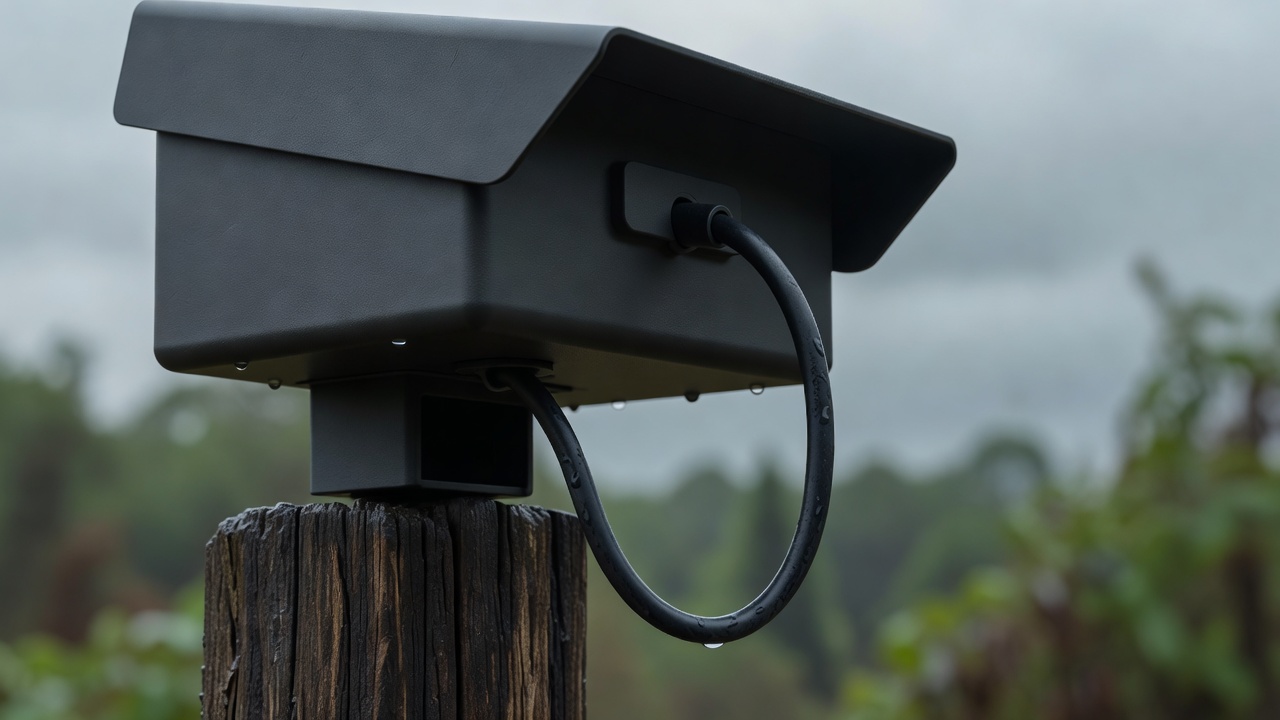
MOUNTING ANATOMY // A deep overhang hood stops drizzle from beading across the glass window, while a downward cable drip loop diverts rainwater away from rubber gland seals.
Before leaving the camera overnight
- Mechanical IR-Cut Filter Test: Listen closely in a darkened room as the camera switches to night mode. If the mechanical filter clicks loudly, increase the mount distance by at least one metre so shy mammals do not startle.
- LED Wavelength Check: Cup your hand around the front array in darkness. 850nm emitters glow faint cherry-red; 940nm emitters remain invisible to the naked eye and attract far less attention from foxes, badgers, and human passers-by.
- Clock & Timezone Sync: Set the internal clock to UTC or local standard time without daylight-saving jumps so year-round dawn arrival charts remain consistent.
- Desiccant Sachet Renewal: Tuck a dry 5-gram silica gel packet inside the battery bay every autumn to prevent internal lens fogging when frost follows a mild afternoon.
- Private Network Isolation: If using a wired RTSP camera, block outbound internet access for the camera's MAC address on your home router so footage remains strictly on your local home drive.